You found it. The hidden truth: the best AI transformations don't start with technology. They start with a conversation between people who refuse to accept the status quo.
An AI talent scout, an AI strategy architect, and an AI transformation professional walked into a room — and realised the biggest obstacle to enterprise AI wasn't finding brilliant people or building brilliant strategies. It was the chasm between the two.
Organisations hire world-class AI talent, then watch them fail — not because of capability, but because the culture, infrastructure, and mindsets aren't ready. The strategy decks are polished. The talent is exceptional. And yet the gap persists.
—dhashly exists to bridge it. We integrate AI talent sourcing, strategic advisory, and deep organisational transformation into one coherent engagement — because that's the only way it actually works.
We believe the future belongs to organisations that treat AI not as a tool to be installed, but as a capability to be cultivated. That means investing in people before platforms, in culture before code, and in adaptability before automation. The em-dash is our reminder: the gap between intention and impact is where the real work happens.

The right talent without the right culture is expensive failure. We source people who don't just fit the role — they catalyse the transformation around them.
Years spent across startups, multinationals, academia, and the creative sector have given Victoria an unusually sharp read on people and culture. She understands that failed AI transformation is rarely a technology problem — it's a people problem. She finds top talent because she listens differently, discovering what matters beyond pay and perks.
"The best hire isn't the smartest person in the room. It's the one who makes everyone else in the room smarter."
Victoria's guiding principle
Strategy without culture change is just a slide deck. Transformation happens when you rewire how decisions are made — not just which tools are used.
A sensemaker for the age of AI. Over 25 years, Nicolas led organisations through the kind of change most people only put in strategy decks. His edge: translating between supervisory boards and engineering teams, between AI capability and business case, between what's possible and what's actually deployable. He thinks in systems, acts in sprints.
"Value today comes from adaptability, not knowledge. The organisations that win are the ones that learn faster than the world changes."
Nicolas's operating principle
AI value isn't unlocked by technology adoption — it's unlocked when organisations learn to think differently about what humans and machines do best together.
A data & technology entrepreneur who converts abstract AI challenges into practical, human-centric innovation. As founder of CoreCortex & Behavioural Economy, Tom helps forward-thinking brands translate AI into measurable impact. He is also an academic researcher and lectures in Data Science, Innovation and AI at universities in the UK, France and Switzerland.
"AI doesn't transform organisations. People do. AI just makes the brave ones unstoppable."
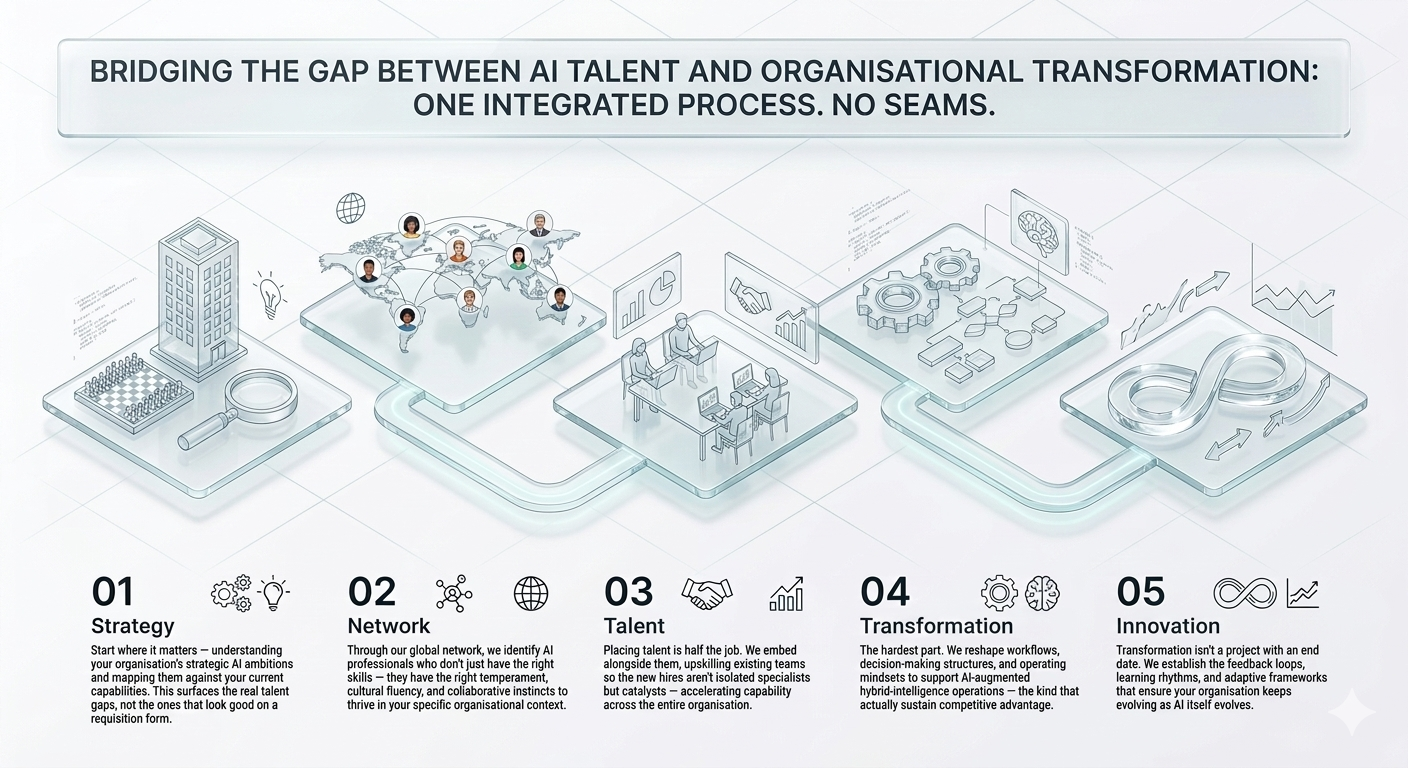
Tom's convictionWe start where it matters — understanding your organisation's strategic AI ambitions and mapping them against your current capabilities. This surfaces the real talent gaps, not the ones that look good on a requisition form.
Most organisations overestimate their AI readiness by 40–60%. Our diagnostic cross-references strategic ambition, skill inventory, cultural receptivity, and infrastructure maturity — giving leadership a sober, actionable picture rather than a reassuring one.
Through our global network, we identify AI professionals who don't just have the right skills — they have the right temperament, cultural fluency, and collaborative instincts to thrive in your specific organisational context.
Technical brilliance without organisational empathy is the number one reason AI hires fail within 18 months. We assess for "translation ability" — the capacity to bridge between deep technical work and the human dynamics of change.
Placing talent is half the job. We embed alongside them, upskilling existing teams so the new hires aren't isolated specialists but catalysts — accelerating capability across the entire organisation.
The critical window is the first 90 days. We design structured integration pathways that pair new AI talent with internal champions, establishing shared language, quick wins, and visible momentum before organisational antibodies kick in.
The hardest part. We reshape workflows, decision-making structures, and operating mindsets to support AI-augmented hybrid-intelligence operations — the kind that actually sustain competitive advantage.
Culture change isn't a workshop series. It's a rewiring of how decisions get made, how failure gets treated, and how collaboration crosses functional boundaries. We work at the level of habits, incentives, and stories — not just processes.
Transformation isn't a project with an end date. We establish the feedback loops, learning rhythms, and adaptive frameworks that ensure your organisation keeps evolving as AI itself evolves.
The half-life of an AI strategy is roughly 8 months. We embed sensing mechanisms — internal and external — so your organisation detects shifts early and adapts by design, not by crisis.
We're fully committed to the organisations we work with — which means we only take on new engagements through direct referrals via our existing network. If you're serious about closing the AI talent–transformation gap, reach out personally through one of our LinkedIn profiles.
Select your organisation size to see an estimate of the first-mover advantage and innovation value you've already left on the table by not starting your AI talent × transformation journey.